


Physics has a reputation for being the school subject that suddenly humbles strong students. A learner can do well in math, read carefully, study hard, and still freeze when a problem mixes motion, force, graphs, and units on one page.
Part of the trouble comes from how physics asks the brain to work. You are not only recalling facts. You are building a mental model of how the world behaves, then testing that model against numbers, diagrams, and language that can feel deceptively simple.
Research in physics education has shown for decades that many students can solve routine numerical problems while still struggling with core ideas in mechanics and electric circuits.
A closer look at the hardest school physics topics shows a pattern. Trouble rarely starts with formulas alone. Trouble starts when students must connect a formula to a physical situation they cannot yet picture clearly. That gap is why some chapters feel manageable in class and then fall apart on a test.
A Quick Look At the Usual Trouble Spots
| Topic | Why Students Often Struggle | Common Mistake |
| Newton’s Laws | Every day intuition clashes with formal rules | Believing motion always needs a force |
| Free body diagrams | Requires careful force identification | Adding forces that are not actually acting |
| Work and energy | Terms sound familiar but mean something precise | Mixing up force, work, and power |
| Momentum and collisions | Conservation ideas feel abstract at first | Treating force and momentum as the same thing |
| Waves and sound | Hard to picture what is moving and what is not | Thinking the medium travels with the wave |
| Electricity and circuits | Charge, current, voltage, and resistance are invisible | Thinking, the current gets used up in a bulb |
| Magnetism and electromagnetism | Direction rules and field ideas stack up quickly | Confusing field direction with particle motion |
Newton’s Laws

At first glance, Newton’s laws look almost too basic to cause major trouble. Force causes acceleration. Objects resist changes in motion.
Every interaction has equal and opposite forces. Straightforward wording, familiar examples, short formulas.
Yet mechanics remains one of the most heavily studied pain points in physics education. PhysPort lists multiple research-based assessments for force and motion at both the high school and college level, which says a lot about how persistent the learning challenge is.
Newton’s First Law and the Failure of Everyday Intuition
A car slows down when you stop pressing the gas. A shopping cart stops rolling if nobody pushes it. A soccer ball loses speed after a kick. From daily life, many students build a rule that says motion dies without a force.
Physics instruction then asks them to replace that instinct with a more precise idea: a net force changes motion, while balanced forces preserve constant velocity.
The Physics Classroom identifies the belief that sustaining motion requires continued force as a major misconception, and that tracks closely with what many teachers see in class.
A classroom example makes the issue clear. Suppose a hockey puck slides on nearly frictionless ice. A student who relies on everyday intuition may predict that the puck needs a forward force to keep moving.
In Newtonian terms, though, once the puck has its velocity, no forward force is required for constant straight-line motion. Friction in ordinary life trains the intuition. Mechanics asks students to separate friction effects from the deeper rule.
Newton’s Second Law and the Problem of Net Force
Formula memory often hides weak conceptual footing. Students may know that F=maF = maF=ma, yet still miss what the equation is really saying.
The crucial idea is net force, not any single force spotted in a diagram. In many test questions, several forces act at once.
Gravity pulls downward, a normal force pushes upward, friction resists motion, tension pulls along a string, and the student has to determine which forces balance and which do not. That is far harder than plugging numbers into a formula.
Free-body diagrams sit at the center of that difficulty. A learner must identify only the forces acting on one chosen object, point them in the correct directions, and avoid adding forces that belong to other objects in the system.
One wrong arrow can ruin the whole solution. When free body diagrams keep causing mistakes, step-by-step problem libraries like Qui Si Risolve can help students see how each force is identified before any equation is written.
The Physics Classroom gives free body diagrams a full place inside its Newton’s laws sequence, which reflects how central the skill is to mechanics learning.
Newton’s Third Law and the Equal Force Trap
Newton’s third law creates a special kind of confusion because it seems to contradict experience. If forces between two interacting objects are equal in magnitude and opposite in direction, why does a truck crush a can while the can barely dents the truck?
Students often think the truck must exert the larger force. In fact, the force pair is equal, while the resulting accelerations differ because the masses differ. Equal force does not mean equal effect.
That idea sounds manageable when stated in a sentence. In a collision diagram or a lab setting, many students still fall back on the heavier object means bigger force idea. School physics gets hard very fast when familiar language like force is attached to a meaning that differs sharply from gut instinct.
Work, Energy, and Power
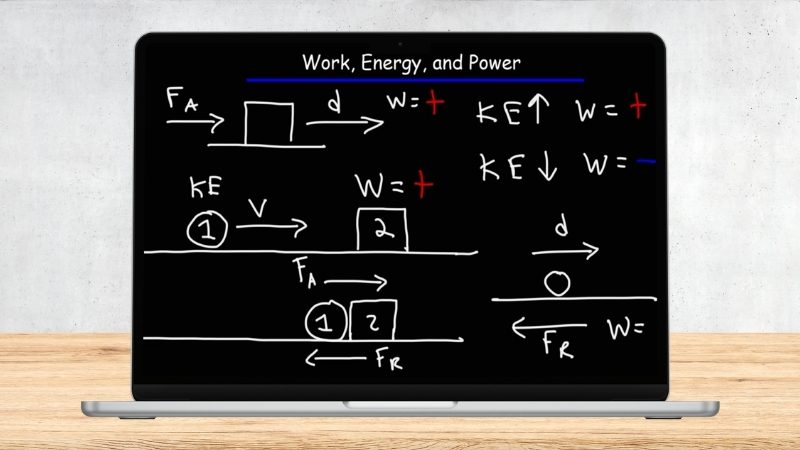
Energy usually looks friendlier than Newton’s laws at first. Many students like the idea that energy provides a shortcut through motion problems. In practice, energy chapters cause trouble because everyday language sabotages precision.
In ordinary conversation, energy can mean enthusiasm, tiredness, fuel, electricity, or mood. In physics, energy is a conserved quantity tied to motion, position, temperature, fields, and more.
Work has an even worse language problem. Outside of class, work means effort. In physics, work requires a force acting through a displacement. A student can push hard on a wall, get tired, and still do zero mechanical work on the wall if nothing moves.
Research cited by the American Physical Society shows that students have documented difficulties with work and mechanical energy, which matches what many instructors report in school settings.
Why Energy Problems Go Wrong
Students often struggle for three reasons:
Take a roller coaster example. At the top of a hill, gravitational potential energy is high. As the car drops, kinetic energy rises.
A student who grasps conservation can solve for speed without tracking the exact forces at every point.
A student who only half grasps the idea may keep asking which force created the speed, then lose the thread.
Power adds another layer. Many learners confuse power with force or energy because all three sound like measures of strength.
In physics, power is the rate of doing work or transferring energy. A person can lift the same box to the same shelf as another person, doing the same work, while producing more power by doing it faster.
Momentum and Collisions
View this post on Instagram
Momentum chapters tend to arrive after students are already somewhat worn down by mechanics. By then, physics starts asking for deeper system thinking. Momentum depends on mass and velocity, and in collisions, the key move is often to treat the total momentum of a closed system as conserved.
That sounds neat on paper. In class, trouble shows up when students mix momentum with force because both appear in impact problems.
A bat hitting a ball feels like a force event, and it is. Yet many collision questions are easier to handle with momentum because the interaction lasts a short time, and internal forces within the system can be left out of the final conservation equation.
The bigger issue is timing and abstraction. Collisions happen too quickly for most students to picture clearly. Without a good diagram, the process feels like a blur.
Elastic versus inelastic collisions add vocabulary that sounds minor but changes the analysis. In one case, kinetic energy is conserved, in the other, it is not, even though momentum conservation still applies to both closed systems.
A common school-level mistake goes like this: a student sees two carts stick together and assumes that momentum disappeared because speed dropped sharply.
What actually happened is that some kinetic energy shifted into heat, sound, or deformation while momentum for the closed system remained conserved.
Physics often becomes difficult at exactly that point, where one conserved quantity survives while another does not.
Waves, Sound, and Light

Wave chapters feel strange because what students see is rarely what is actually moving. A pulse travels down a rope, but the rope itself mostly moves up and down locally.
Sound travels through air, but the air does not rush across the room from speaker to ear. Many students carry over an object-based picture of motion into a wave-based topic, and then the errors start piling up.
Frequency, Wavelength, and Speed
Wave questions force students to coordinate several linked quantities:
Each term has a role, and changing one may or may not affect the others, depending on the medium and the situation.
A student may memorize v=fλv = f\lambdav=fλ and still miss the logic. If wave speed stays fixed in a given medium, then raising frequency shortens the wavelength. Many errors come from treating all variables as independent.
Sound adds another trap. Loudness and pitch are often confused. Loudness is mainly tied to amplitude. Pitch is tied to frequency. Because the ear blends several sensory impressions into one experience, the physical distinctions do not always feel obvious.
Light pushes things further because it mixes wave behavior with optics vocabulary like refraction, reflection, focal points, and image formation. A learner has to picture geometry and wave behavior at the same time.
Electricity and Circuits
@missmmartins Electric circuits – Physics! Comment what you want next! #study #school #exams ♬ original sound – Science & Maths teacher 🍎
For a huge number of students, electricity is where school physics becomes truly slippery. Mechanics at least deals with visible objects.
Circuits deal with charge, current, voltage, and resistance, none of which can be watched directly. Students often rely on metaphors, and many of those metaphors are wrong.
Physics education research has flagged persistent conceptual problems in electric circuits for years. AAPT materials summarizing that work note that students may solve standard circuit calculations while still lacking a sound conceptual model.
The same resource highlights recurring beliefs, such as the battery acting like a constant current source and current being used up in a circuit. The Physics Classroom also lists the false idea that less charge exits a bulb than enters it.
Current, Voltage, and Resistance Often Get Blended Together
A major source of confusion comes from three quantities that interact closely but are not the same thing:
Students often remember the names without having a clear picture of the relationships. Then Ohm’s law, V=IRV = IRV=IR, turns into another plug and chug formula.
Consider a simple series circuit with a battery and two identical bulbs. Many learners predict that the first bulb uses up some current, leaving less for the second. In a steady state series circuit, current is the same through each component.
Energy per unit charge changes across elements, which is why voltage drops matter, but charge is not consumed in the bulb. That distinction is conceptually hard because everyday language around electricity often treats current like a substance that gets spent.
Series and Parallel Circuits Expose Weak Mental Models
Parallel circuits add another layer of difficulty because students must track shared voltage and split current. One small wiring change can alter the whole behavior of the system. Without a visual and conceptual model, many answers become guesses.
AAPT’s summary of instructional research reports that on qualitative bulb brightness questions, correct responses in standard lecture settings were very low, even among large groups of calculus-based students.
That finding matters because brightness ranking sounds like an easy classroom exercise. In reality, it reveals whether the learner has a coherent model of current, potential difference, and circuit structure.
Graphs, Units, and Mathematical Translation
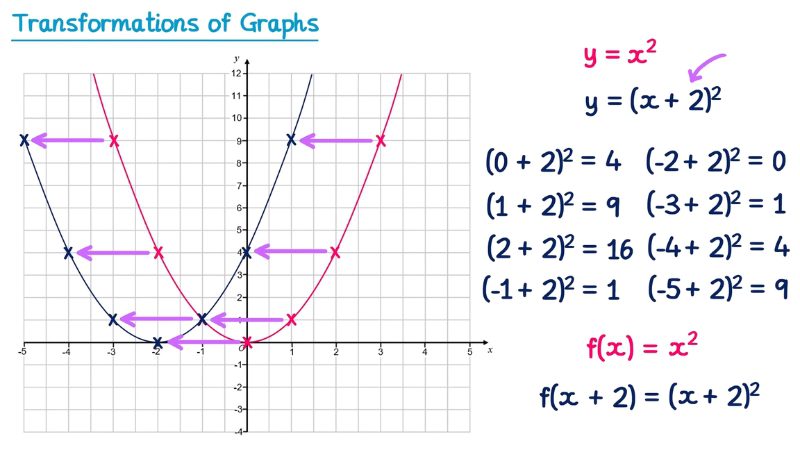
Many students say a chapter is hard when the real issue sits underneath the chapter. Physics depends on translation between math and physical meaning. A position time graph, velocity time graph, or current voltage graph can defeat a student who otherwise knows the vocabulary.
PhysPort includes research-based assessments not only for mechanics and circuits but also for graphing, vectors, and mathematical modeling, which reflects how often representation skills are part of the actual obstacle.
Units are another silent troublemaker. Physics rewards students who treat units as clues rather than decoration. If a calculation for speed ends in newtons, something went wrong.
If electric power comes out in amperes alone, the setup likely missed a voltage factor. Strong students often improve dramatically once they stop seeing units as something to tack on at the end.
Why Better Students Still Struggle
A frustrating part of school physics is that effort does not always produce immediate clarity.
AAPT’s research summaries, which we mentioned earlier, point to a long-standing pattern: students may perform well on standard quantitative exercises while still showing weak conceptual reasoning on qualitative questions. Traditional instruction alone often does not fix that gap.
That is why a student can say, with total honesty, “I studied for hours,” and still miss problems that look slightly different from homework examples. Memorized procedures help only until the question changes shape.
Practical Ways To Make Hard Physics Topics More Manageable

Students usually improve faster when they change methods, not only when they increase study time.
Start With the Physical Picture
Before writing any formula, identify:
In mechanics, draw the forces. In energy problems, define the system. In circuits, mark series and parallel relationships before calculating anything.
Use Words Before Equations
A short sentence can expose confusion early. For example:
- “Net force is zero, so acceleration is zero.”
- “Current is the same everywhere in a series branch.”
- “Momentum is conserved for the closed system.”
That habit helps because many errors begin when a student writes equations before deciding what the physics is saying.
Treat Qualitative Questions Seriously
Research highlighted by AAPT argues that facility with standard quantitative problems is not enough to judge functional learning. Questions that require explanation and qualitative reasoning reveal whether the concept is actually solid.
A simple brightness ranking problem or force comparison can teach more than a full page of arithmetic when used the right way.
Revisit Misconceptions Directly
Good physics study often involves correcting a bad mental picture. That means asking blunt questions:
When students confront the mistaken picture directly, the correct model has a better chance of sticking.
Final Thoughts

The hardest physics topics in school are usually the ones that force students to stop trusting first impressions.
Newton’s laws challenge intuition. Energy demands precise language. Waves separate motion from material transport. Electricity asks learners to reason about processes they cannot see.
That challenge traces back to Isaac Newton, whose work reshaped how motion and force are described with strict clarity.
Once those topics begin to click, physics usually feels less like formula hunting and more like a coherent way to explain the world. That shift is where real progress starts.